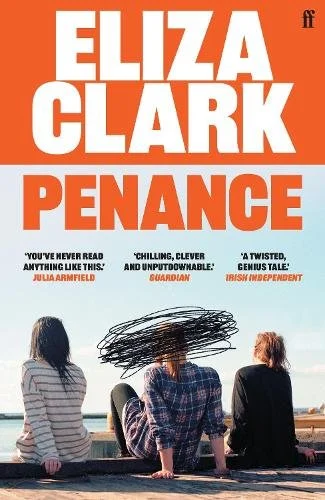
Parasocial True Crime: Penance by Eliza Clark
Originally published January 19th 2024
If you haven't ever found yourself obsessively researching some morbid true crime story (I have, many, many times) perhaps you won't find this book quite as powerful and thought-provoking as I did. Penance is my first 5* read of 2024 and I found it completely unforgettable.
Penance follows the grim (fictional) death of a teenage girl murdered by classmates on the evening of the Brexit vote of 2016. The story is covered by a disgraced journalist (who admits he was implicated in a 2010 phone hacking scandal that anyone from the UK will know well) who is trying to claw back his credibility while grieving for his own dead daughter. He travels to the fictional northern seaside town of Crow-on-Sea to experience the place where awful things have occurred, to go to the scenes of the crimes, and to interview the people most intimately involved. It isn't all fictionalised though. Recognisable non-fiction elements are referenced frequently, from the Columbine killers to 'Vance Diamond' (a background character overtly based on Jimmy Savile).
This isn't a point A to point B type novel, instead positing itself as an attempt to piece together the why of the crime, with personal testimony, written accounts, newspaper articles, and interviews. I can imagine a version of this book with an insert of glossy full colour reproductions of the real crime scene photos. As we come to learn, personal testimony and written accounts however don't always bring forth pure truth. They are always coloured with bias and make the why even harder to ascertain.
Being firmly set inside the England of 2016, Penance also utilises contemporary found sources in the form of blog posts, tumblr extracts, podcast retellings, which only further fuels the bias and misinformation. As someone who has read my fair share of true crime books and as a millennial who once upon a time used tumblr myself, this is exactly what makes the story so strikingly familiar. At times, it becomes painful. This kind of story could have been happening among the very tumblr circles I moved in all those years ago. For all I know, it did.
Penance covers some important contemporary themes and questions. Does violent content online make us violent in the same way we thought that video nasties did in the 80s? Can the bullied become bullies themselves, and if they can, are they justified in their behaviour? Should impressionable teenagers be allowed such unfiltered, unsupervised access to morbid topics online?
My main take away from Penance was the question of the true crime industrial complex and the ethics of its online consumption. There is no dispusting that it has become an increasingly inappropriate and parasocial act. I mean, 'True Crime' has its own dedicated section on Spotify Podcasts. Is it really healthy for any of us, even the most balanced individuals, to be consuming so much real-life horror and evil day after day? Is it in any way ethical to make an interest in true crime part of your personality?
Clark doesn't provide any answers to these questions or concerns, nor do I think she could or should. This isn't an old phenomenon that we are looking back on with the benefit of hindsight. It's happening now. When Gabby Petito went missing while travelling with her boyfriend in 2022, Tiktok and Twitter was rife with armchair detectives with their theories about what had happened, who Gabby was, who her boyfriend and his family were, and this speculation was often presented as fact. Was any of that really helpful - or did it cause pain to the people who loved her, and muddy the waters for the detectives actually investigating?
Clark paints a, quite honestly, awful picture of Brexit England. A deserved one. With politicised EVERYTHING, lost youth, class distinction more obvious than ever, poverty and depression and alienation, and a complete loss of hope. With the title Penance, we should ask ourselves, who is doing the Penance here? Is it the people committing the crimes? Is it the narrators and book writers, generating profit from death and pain? Is it the podcast creators who regularly talk in derogatory terms about victims of horrific crimes, speculating and fueling rumour? Or is it all of us - consuming this content day after day after day, and then screaming for more?