Body, Space, and the Anti-Portrait: visual poetry of Francesca Woodman
“Photography apparently figures time itself as a progressive linear movement from past to future. The present…. a hallucinatory hovering that imbricates both past and future.” - Geoffrey Batchen
The art world experienced a seismic shift during the 1970s. One of the most important and thankfully enduring movements was that of feminist art – or equally, simply just art created by females. Having previously been dominated almost entirely by the patriarchy, a great liberation for women in both politics and society gained momentum. Theory within art changed too, with questions of identity, gender and representation becoming significant along with the image transcending from documentary tool to an expression of feeling.
Whether she truly realized it or not, Francesca Woodman was a young artist working right in the centre of this shift and still remains today an intense and lasting influence for contemporary artists because of her distinctive visual syntax. Woodman was just a teenager making beautiful pieces incorporating the female body, and was not concerned with a societal gaze upon it; instead she played with these kinds of preconception. If anything her photographs are of womenforwomen, something that was at the time relatively unheard of.
“Less than 5% of the artists in the Modern Art sections are women, but 85% of the nudes are female" - Guerilla Girls
Positing herself on the precipice of any gendered reading only adds further to the ambiguity surrounding her already opaque, fairly unreadable work.
Her suicide at 22 remains the fractured glass through which many view and read her work, and as she led such an enigmatic existence during her life, little is truly known of her intentions. This makes her work symptomatic of some kind of ‘Van Gogh syndrome’; a syndrome that’s never useful in any analysis. There really is no evidence to suggest her work is about anxiety, unhappiness, alienation or what we know retrospectively of her depression. In fact, a short video clip of Woodman working in the 1970s shows her exclaiming “the beautiful shade! I’m so pleased!”.
One clear motif running through many of her photographs is that of her relationship to space itself, and her movement between the physical and what could be a more spiritual reality. A second theme is her playful take on and deconstruction of the concept of the self-portrait. She features in a large proportion of her own work (but often uses models) and what she chooses to leave of herself outside of the frame is just as crucial as what she allows us to see. Her art seems to attempt to redefine the boundaries of the expectations of the portrait.
HARMONIOUS BODY & SPACE
During 1976 in Providence, Rhode Island, Francesca Woodman made a short series of images entitled simply House. These images are not presented with any handwritten text and are particularly exemplary of Woodman’s pure relationship to the space she inhabits, to the point that she becomes a fibre in natural fabric of the environment. Everything she does is staged and she doesn’t try to convince the viewer otherwise. Her framing and choice of clothing/non-clothing, or her choice of a certain corner of a room are distinctly calculated.
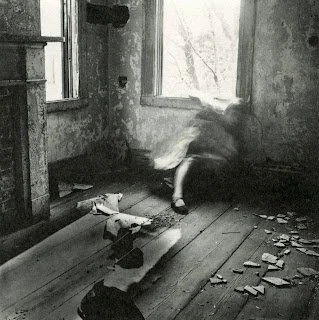
House #3
House #3 shows (what we can only perceive to be) Woodman beneath a window in a small corner of any empty room. The wooden floor is littered with debris, and paint peels from the walls. The windows are slightly overexposed but we can just see a tree outside. A disused fireplace shows just within the frame but from what we can see there is no other furniture. Woodman herself is but a blur, only one foot seeming to have any solidity to it – her body and face are only just there, making her a ghostly presence rather than a human one. We cannot properly tell what she is wearing.
This room isn’t one that is lived in; it is clearly derelict. A once domestic setting that is now deconstructed, showing its bare bones and the paint once of aesthetic and material value now disintegrating. One skin is shedding and another appears underneath, allowing Woodman to creep into the gap created and into the fabric of the room meaning she doesn’t just exist in it, but becomes an organic limb of the decaying walls and isn’t the passive victim like the Victorian heroines she is documented as having been inspired by.
The blurring means she hovers above the chasm of narrative and the frozen. In a sense Woodman is defying the very purpose of photography itself by using it to wither repetitively in a longer, drawn-out moment, rather than a minute snapshot of time. The resistance of traditional techniques of photography is clearly deliberate, and when coupled with the short video pieces Woodman made during her life, seem to construct an ongoing performance art where she isn’t “being” someone else, but consistently representing some part of herself and nothing more. She allows her own image to loop continuously.
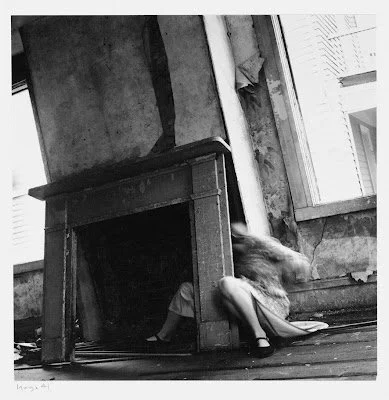
House #4
House #4 appears to be created in a similar (if not the same) space as House #3. In this we see a wall taking up a large proportion of the frame, and a removed fireplace propped against it. A blurred figure squeezes itself in the small space between the fireplace and the wall, and like House #3 only the feet and legs are solid points. There are two windows either side of the main wall, but both are mostly cropped out of frame. Wallpaper is peeling from the walls, and the small amount of floor we see is dusty and dirty. In so many ways House #3 and #4 are the same image, showing the same things, showing the same Woodman in a transitory state. The domestic setting is one that is both familiar and unfamiliar; it’s like a displaced memory of something we all recognize, giving it an inherently dreamlike quality. The repetitive nature of her actions adds further to the idea of this being more of a recurring dream than actuality. A diary entry written by Woodman states
“Photography is too connected with life. I take pictures of reality as filtered through my mind.”
The visual language relies on you to participate through deciphering your own meaning; and as such becomes as personal to you as it is to Woodman.
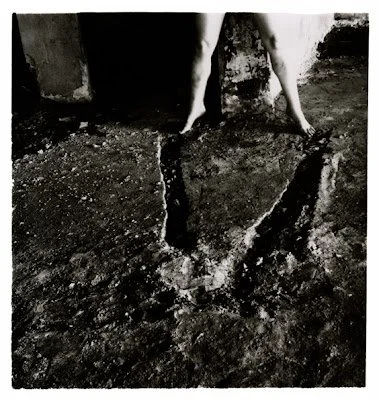
From Angel series, Rome
An image from her Angel series depicts these same ideas but uses differing techniques. There are two large grooves dug out of an uneven, uncovered floor. Being lit from the side gives the debris and unevenness a strong texture, so much so you want to brush your fingers along it. Mirroring the two grooves we see two spread and unmoving legs propped on the balls of their feet. Angel is almost entirely in focus (so unlike House uses predominantly traditional photography techniques), instead using juxtaposition of the smooth unblemished skin of the legs against their harsh surroundings, to create an odd and contradictory harmony. The framing is just so that you see to the very tops of the thighs before your view is cut - what can only be seen as a very teasing nod from Woodman who is deliberately threatening the objectifying [male dominating] gaze. The visual punctum remains, in such an unsatisfying way, just beyond your vision. This is also a slightly surrealistic way of framing, reminiscent of more surrealist photographers like Bill Brandt.
Not only this, but by sidelining the desire of the viewer she forces herself as the ‘subject’ into a new position. She isn’t a subject, and this isn’t a portrait. Despite the clear differences in appearance of her skin and the crumbling, fading skin of the room she is in, her naked and pure state makes her a seamless part of the surroundings. Deciding to be unclothed for an image like this is just as important (if not more so) than the decision of what could be worn.
Our natural reading of this image is – the legs mirror the grooves in the floor. This simple equivalence and displacement works to position Woodman as part of the landscape. Space and Woodman become inseparable entities.
ANTI-PORTRAITURE
What is a self-portrait? Self-portraits are generally considered to be a likeness, a ‘performance’ of a character, giving visual signifiers to who they are and the kind of life they have. An edited autobiography is represented within the frame, as the artist themselves wishes you to see them. They are only ever representations and their status as genuine is always in question. Woodman is clearly aware of this kind of definition of the genre, and like discussed previously, seems intent on using it but above, below and around it rather than through.
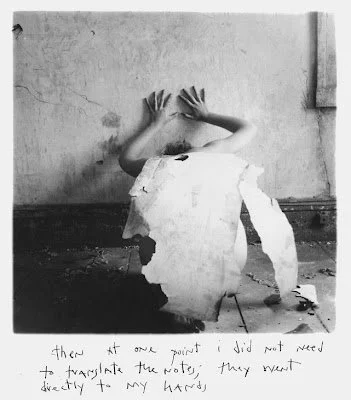
Then at one point i did not need to translate the notes; they went directly to my hands
Then at one point i did not need to translate the notes; they went directly to my hands shows a hidden figure, back to the camera, perched on their knees and bent over, braced against a dirty wall. Ripped wallpaper covers their back. The most striking thing about this is how perfectly the wallpaper seems to sit like a new skin on top but as is now clear, this undercuts our expectations by covering the human bone structure underneath. You cannot see the vertebrae just beneath the surface - it’s become too seamless. It’s another part of life, another dream, as filtered through Woodman’s mind. In many ways this actually perfectly represents the defining features of the portrait – it’s an edited representation of (and by) the artist.
The wallpaper also puts the identity of Woodman in a state of flux in two ways – by physically hiding her and by forcing into your mind the very literal and paradigmatic image of a second skin. It joins neatly with the idea of a shifting identity, rather than Woodman presenting herself as a whole. She transforms before us, not into another human being or character, but simply into the wall. This is a concept that is hugely important in feminist and post-structuralist art – identity is fluid. A self-portrait generally anticipates a one-on-one transaction with viewer and artist. Eye contact or at least some form of identification takes place. Although we can be fairly certain it is Woodman in the photograph she has her back to us and both hides and transforms; the expected transaction cannot be reached. Chris Townsend in his monograph on Francesca Woodman coins the term ‘anti-portrait’ for this.
Most of the floor is in darkness but what we can see is littered in debris, much like House #3 and #4. There are cracks and blemishes in the fabric of the wall. A handwritten caption is underneath which inevitably colours our reading of the overall piece. It's a poetic prose, one that like her images seems opaque but on the outside looks to be speaking of something just ‘coming into being’. Fitting in every sense. However, the text bears little in the way of a clear relationship to the image itself- the only likeness is that of the hands. This creates a tension between text and image and puts them at a surreal parallel to one another. It’s not a simple caption and clearly had more meaning to the creator than to us, retrospectively. The hand of the artist and their fragments of poetry make it seem increasingly personal, and as a viewer you feel you’ve seen something you shouldn’t have. You’ve nonchalantly opened Woodman’s diary.
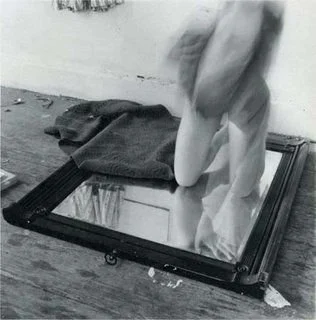
Untitled
Untitled shows a blurred figure kneeling on a large framed mirror. The mirror and figure take up the majority of the frame. The mirror takes part in the self-transformation of Untitled. Acting together with the blurring and movement as a physical manifestation of a ‘portal’ (the portal photography becomes between fantasy and reality), making sure we realise that this Woodman is a doppelganger for the real Woodman. Unlike the two House images, this setting seems much more of a ‘lived-in’ home environment and altogether more domestic. Like the two House images, the figure is blurred and only the thighs and legs are unanimous. Again she refuses to give the audience their desires.
She so completely defies the self-portrait – it’s Woodman, but she hides within the frame. She hides within the time loop she’s created for herself.
As a whole, Woodman’s work seems more like journal entries than pieces created for exhibition. This could be considered to be entirely more intimate and personal and reflective than self-portraits are ever intended – and yet, she remains the enigma.
Jean Baudrillard concludes that
‘Photography is a disappearing act’,
and Francesca Woodman encapsulates this belief.
